

Every school administrator in Kenya knows the feeling. Break time arrives, 150 children pour outside, and within four minutes the playground is either a joy to watch or a queue management problem.
The difference almost always comes down to the same thing: whether the playground equipment for schools in Kenya was designed for that volume of children or whether it was designed for something smaller and stretched to fit.
This guide is for the people making the purchase decision — heads of school, procurement officers, estate managers. Not a product catalogue. A practical breakdown of what to think about before spending the budget.
Children who play actively during break time are better learners in the afternoon. That’s not a motivational statement — it’s what the research consistently shows.
Active outdoor play builds gross motor skills, cardiovascular fitness, and coordination in ways that no classroom activity replicates. For primary-age children, this physical development directly affects concentration and behaviour in lessons.
The playground is where children learn to negotiate, take turns, manage conflict, and work as a group. None of that happens in a queue.
Good outdoor play equipment Kenya schools’ installation gives children enough to do that social interaction becomes part of the play itself, rather than a waiting exercise.
The most common purchasing mistake Kenyan schools make is buying equipment designed for 20 children and putting it in front of 150.
The result is predictable: one slide, one queue, constant teacher involvement to manage it. The equipment isn’t the problem. The capacity is.
When specifying school playground systems Nairobi schools need, calculate the number of children who will use the equipment simultaneously at peak time — not the total school roll, but the number outside during a single break period. Then find equipment designed to handle that number.
A single-tower playground concentrates children in one place. A multi-tower system spreads them out naturally.
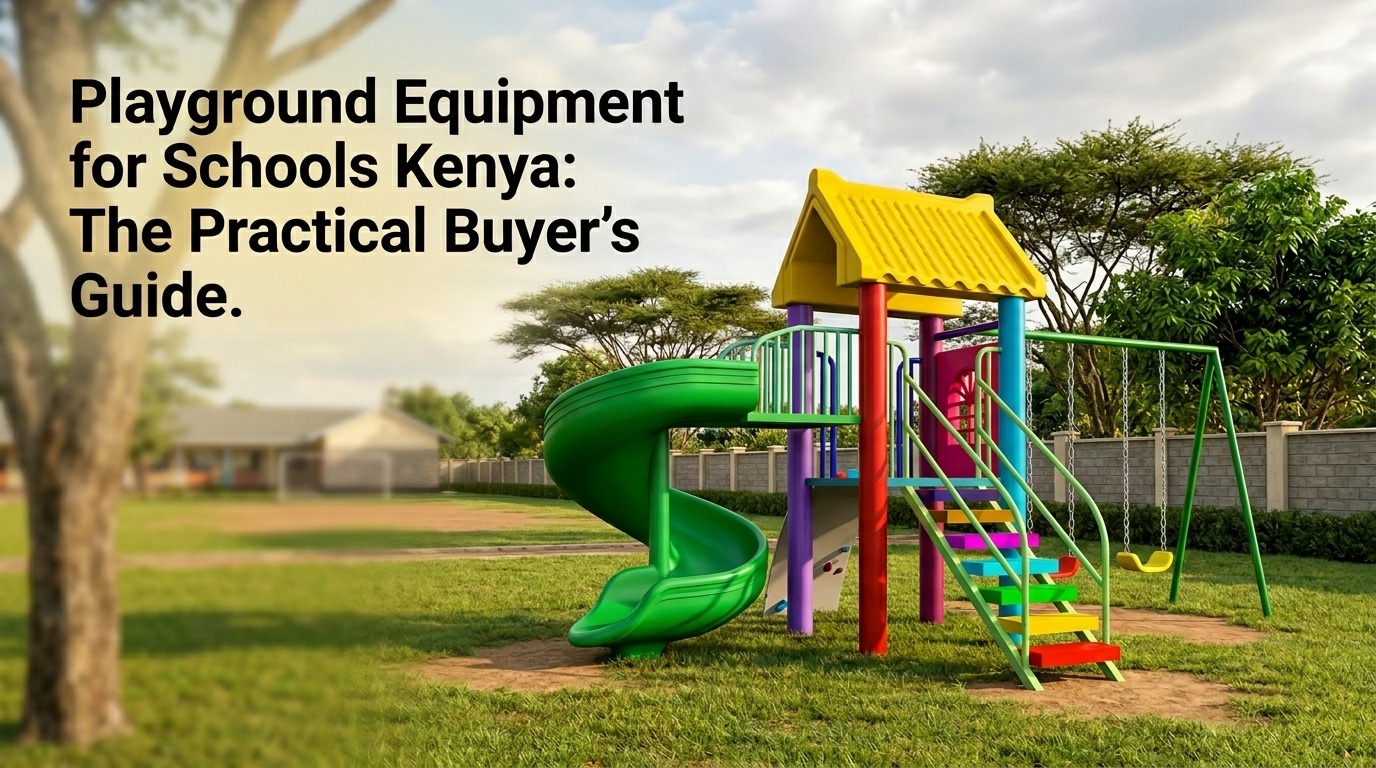
The Polyplay Play Station Ppl 3T 12 is one of the clearest examples of how this works in practice — three connected towers with twelve play activities, enough variety that children disperse without being directed to. It’s built specifically for the high-volume environment Kenyan schools operate in.
There’s a meaningful difference between playground equipment made for a home garden and commercial playground equipment. The materials are different. The structural tolerances are different. The expected daily use volume is completely different.
A home garden structure might see two or three children for an hour a day. A school structure sees 100 to 200 children across multiple break periods, every single school day, in the Kenyan sun and rain.
Commercial playground equipment Kenya schools buy needs to be rated for such usage. If a supplier cannot tell you what usage volume their equipment is rated for, that’s an answer in itself.
UV-stabilised plastics are non-negotiable. Unprotected plastic components become brittle and crack within two to three years under equatorial sun.
Steel frames need corrosion resistance treatment throughout — not just surface coating on visible parts. In coastal schools near Mombasa, or in high-humidity inland areas like parts of Kisumu, inadequate rust-proofing shows up within months.
Joints and fixings matter as much as the structural members. Loose fixings are the most common cause of early structural failure in playground equipment. Quality equipment uses heavy-gauge fixings with locking mechanisms, not standard hardware.
Safety for safe playground equipment for primary schools starts before installation, with the ground surface.
Bare soil, concrete, or compacted gravel under climbing equipment is inadequate. A child falling from two metres onto hard ground will be seriously injured. Safety surfacing — rubber matting, wood chips, or impact-absorbing material — needs to cover the fall zone around the entire structure.
The fall zone should extend at least two metres beyond the outermost point of the equipment in every direction. This is the standard recommended by IPEMA (International Play Equipment Manufacturers Association), the body that certifies commercial playground equipment against independently tested safety requirements.
Primary schools typically have children from age 6 to 14 on the same playground. Equipment should offer appropriate challenge across that range, not just suit one end of it.
A structure with only very high climbing elements excludes younger or more cautious children. A structure with only low, simple activities bores older children quickly. Multi-tower systems with varied activity heights and types handle the range without needing separate equipment zones for each age group.
Equipment layout affects how easy the playground is to supervise.
Open structures where teachers can see all activity zones from one or two positions are significantly easier to manage than enclosed structures with blind spots. Ask suppliers about sightline design before purchase — it’s rarely mentioned in brochures but it matters every single break time.
Planning the Full School Environment — Outdoor and Indoor Together
Outdoor play and indoor learning are connected. Children who come in after a break having had genuine physical activity and social interaction settle into lessons faster and stay focused longer.
The classroom environment matters equally. The school furniture Kenya primary schools choose — the desks, chairs, and benches children spend most of their day in — directly affects comfort, posture, and concentration.
Polyplay supplies both. For a full picture of what to specify for the indoor classroom environment alongside outdoor play equipment, the Polyplay guide for school furniture covers material specifications, size ranges by age group, and the cost-per-year calculation that changes most procurement decisions.
Correct installation of commercial playground equipment is not optional. Bolt torque, anchor depth, and platform levelling all affect long-term structural stability. Equipment that looks fine on day one but was installed incorrectly will develop movement and instability over months of use.
Always confirm that installation is included and carried out by trained personnel, not left to site staff working from a manual.
Even well-specified equipment needs regular inspection. A monthly visual inspection for loose fixings, worn components, and surface damage catches problems before they become hazards.
Establish a written inspection log. Schools that document inspections consistently are in a far better position if equipment failure ever raises a liability question. Schools that don’t are not.
Polyplay recommends an inspection schedule based on usage volume — a high-traffic primary school with 300 children will need more frequent checks than a small community estate playground with lighter daily use.
What playground equipment is best for a Kenyan primary school with 200+ pupils?
Multi-tower systems are the right choice for high-volume schools. A structure like the Polyplay Play Station Ppl 3T 12 — three towers, twelve activities — spreads children across the equipment naturally, reducing queuing and the supervision burden on teachers. Single-tower structures simply cannot handle 200 children across a break period without becoming congested.
How do I know if playground equipment is safe enough for my school?
Ask suppliers whether their equipment meets internationally recognised standards, such as those certified by IPEMA. Ask specifically about fall zone requirements and what safety surfacing they recommend for the equipment. Any supplier unable to answer these questions with specifics is worth reconsidering.
What is the difference between residential and commercial playground equipment?
Residential equipment is designed for light home use — typically two to four children for an hour or two a day. Commercial playground equipment is designed and rated for heavy institutional use, with structural tolerances, material specifications, and fixing hardware that reflect the difference. Using residential equipment in a school environment leads to early failure and safety problems.
How much outdoor space does a school need before buying a multi-tower playground?
It depends on the specific structure, but the equipment footprint is only part of the calculation. Fall zones need to extend at least two metres beyond the structure in all directions. Polyplay’s team can advise on minimum space requirements and conduct a site visit before any purchase is confirmed.
Should playground equipment and school furniture be bought from the same supplier?
It simplifies procurement, installation coordination, and ongoing support. Polyplay supplies both outdoor play equipment Kenya schools need and the indoor furniture — durable classroom chairs, tables, and kindergarten furniture — that goes alongside it. Visitpolyplay.co.ke for the full range.

